














$220 SAVE $130 = 37.0% Western Digital 16.0TB Western Digital Ultrastar DC HC550 3.5-in… in Storage: Hard Drives
|
|

|
|

|

|
Leica 35mm f/1.4 Summilux-M ASPH 2010

Related: distortion, field curvature, focusing, Leica, Leica 35mm f/1.4 Summilux-M ASPH, Leica Lenses, Leica M, Leica M lenses, Leica Summilux, Leica Summilux-M, optics
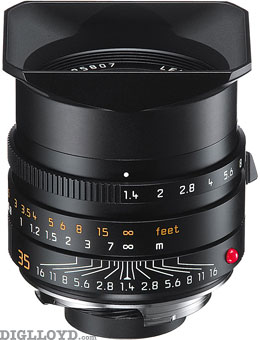
The new 35mm f/1.4 Summilux-M ASPH is a revised version of the already famed 35mm f/1.4 Summilux-M ASPH. The new lens is described by Leica in glowing terms:
- A floating element which ensures top image quality at all focusing distances;
- All-metal rectangular lens hood similar to the 21/1.4 and 24/1.4Summilux-M lenses;
- “Performance characteristics without precedent for compact 35mm lenses”;
- Reasonably low field curvature;
- Near absence of coma by f/2.
- The lens is nearly optimal in its imaging by f/2 (claimed).
| Focal length: | 35.6mm |
| Aperture scale: | f/1.4 - f/16, 9 blade aperture |
| Angular field, diag./horiz./vert | 63/54/37° |
| Focusing range: | 0.7m to infinity |
| Coverage at close range: | 1:17.4, 418 X 626mm |
| Number of elements/groups: | 9 Elements in 5 groups, with “floating” group |
| Filter thread: | Internal 46mm threads. |
| Weight (nominal)): | 320g |
| Dimensions (with caps): | 46mm, 58mm with lens hood, 56mm diameter |
View near real-time pricing and availability for Zeiss ZM an Leica M lenses on the Leica M gear page.

Outstanding choice on the M9
The 35mm focal length is perhaps the friendliest focal length of all on the M9, offering a generous view though the M9’s viewfinder. If you’re shooting the M9, the 35mm focal length is the most comfortable best all around choice.
Distortion
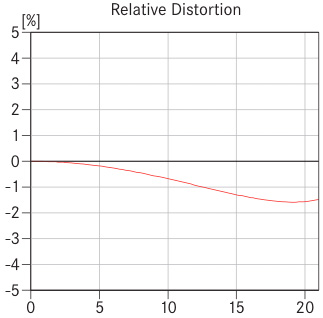
Distortion is relatively low for a 35mm lens, but will show up on buildings or horizons. Barrel distortion occurs out to the frame edges, then flattens and reverses to slight pincushion distortion into the corners. This is a type of “wave” distortion.
MTF (contrast and sharpness)
Performance is very high for a 35mm lens, but field curvature is prominent, showing up as a wave in the MTF curve near the mid zones, so crispness cannot be expected across flat (planar) subjects. This is not ideal, but stopping down to f/5.6 takes care of that nicely, just remembering that peak performance is not in a geometric plane, but a zone. Some astigmatism is present, and this is closely related to field curvature, but also to uncorrected color aberrations.
Overall contrast on “3D” subjects looks to be world-class.
Mouse over the apertures below to compare.
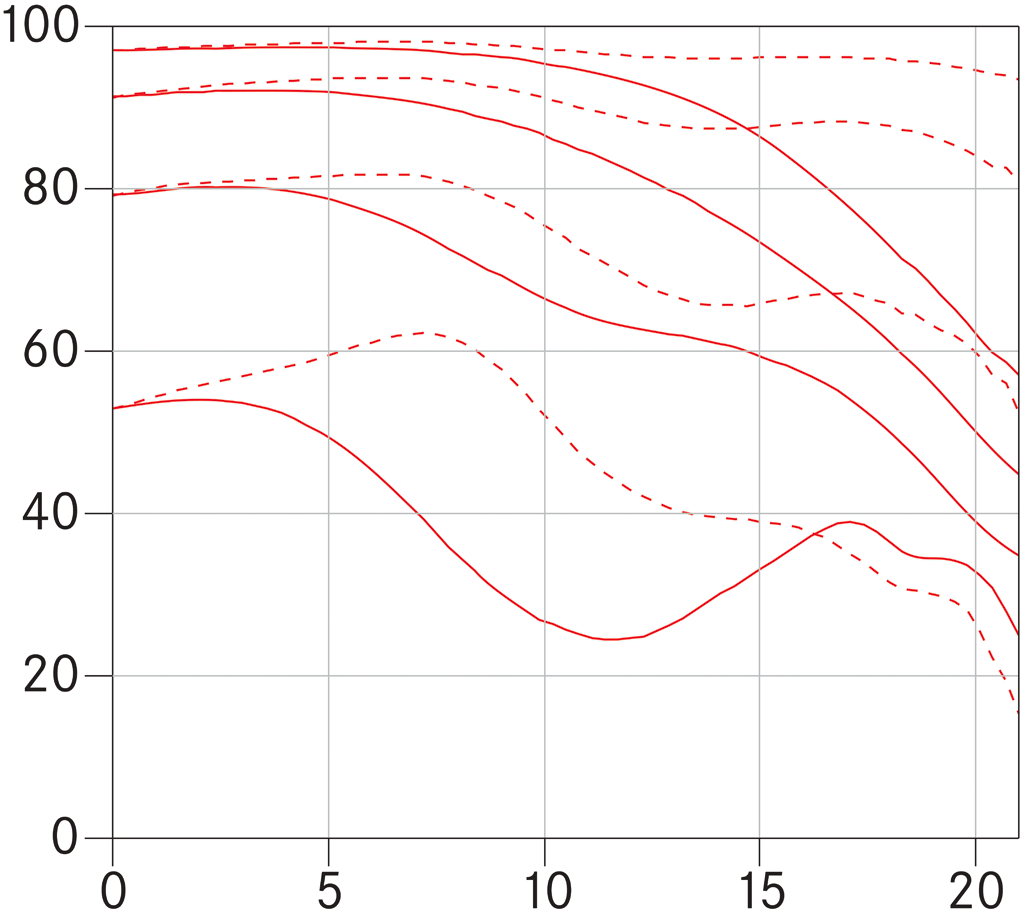
Image quality in the field on real images
Initial shooting shows exceptionally high wide-open image quality, but with fairly strong magenta/green color bokeh, and moderately distracting out of focus rendition at f/1.4 towards the corners, but of a sort typical of many f/1.4 lenses at full aperture.
Compared to the Zeiss 35mm f/1.4 Distagon (for Nikon or Canon), wide-open image quality shows higher contrast and sharpness, but bokeh that is less pleasing over the full frame.
Aperture
Half-stop click-stops are marked in full stops. I prefer the clearly-marked 1/3 stop increments on the Zeiss ZM line. But it’s a moot point given that each brand has its own approach.
Composing
The 35mm focal length is perfect for the Leica M9, the very most “friendly” choice in terms of view and focusing.
Ergonomics
I’m not a fan of the “tabbed” focusing approach (terrible ergonomics for fine focus adjustments), I much prefer the ribbed focusing ring of the 21/1.4 Summilux-M ASPH, but that’s probably a sacrifice due to the compact size.
Focusing
Excellent. I find that the 1.25X magnifying eyepiece is quite helpful for accuracy, with the frame lines still fully visible and usable.

Seagate 22TB IronWolf Pro 7200 rpm SATA III 3.5" Internal NAS HDD (CMR)
SAVE $100